

The gap between Big 4 and nothing and 3 more
Shared by Riscova Newsletter · November 15, 2026
Read the original on riscova.com
The gap between Big 4 and nothing and 3 more
The gap between Big 4 and nothing
Between a $100K consulting engagement and doing nothing, there used to be no option.
That gap has quietly shaped how mid-sized companies manage ERP health for the last decade.
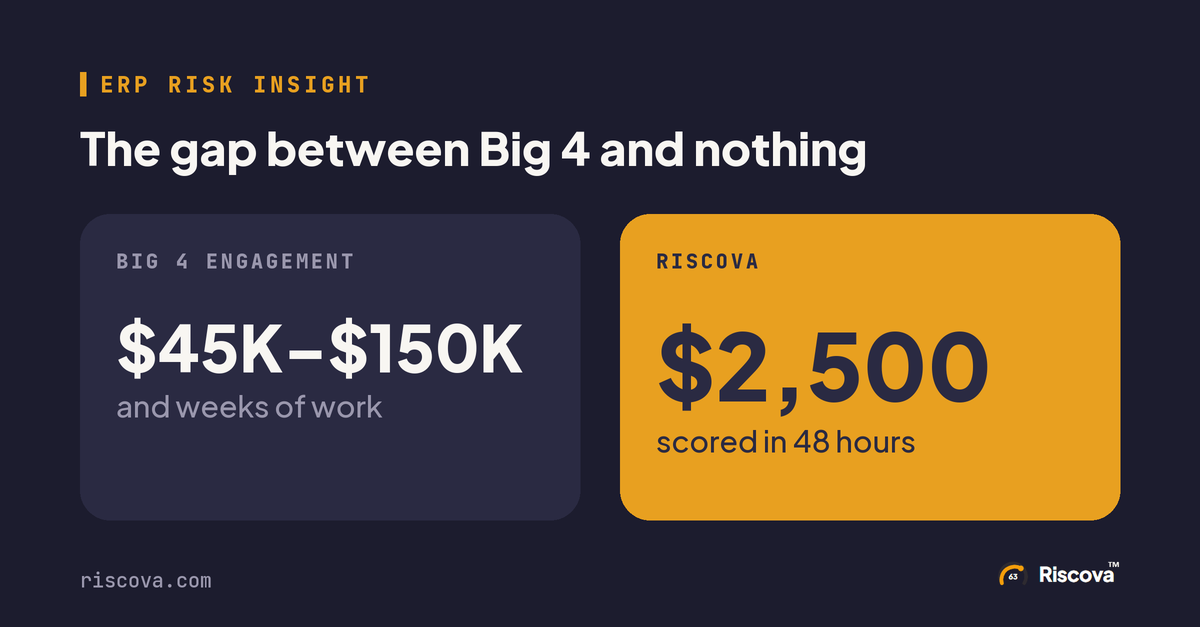
A Big 4 firm will happily scope an ERP assessment for you. The engagement runs $45,000 to $150,000. It takes six to ten weeks. It requires a project manager on your side just to coordinate interviews and data pulls.
Most mid-sized companies look at that price tag, look at their budget, and close the laptop.
So nothing gets checked. Not because leadership doesn't care, but because the only option on the table was built for a company three times their size.
Here's what actually happens in that silence:
- Configuration drift goes undetected for years. Someone changes a workflow approval in 2022 to fix a one-time problem. Nobody reverses it. By 2025 it's load-bearing and nobody remembers why it exists.
- Security roles pile up. New hires get copied from an existing user "to save time." Three reorgs later, half your AP team has access they shouldn't have.
- Customizations nobody can explain. The system has forty custom fields. Five are used. The rest are legacy scar tissue from a consultant who left in 2019.
- Integration points nobody owns. Data flows between ERP and three other systems, and the mapping logic lives in one person's head.
None of this shows up on a balance sheet. All of it shows up eventually, in an audit finding, a failed SOX control, a botched upgrade, or a breach that traces back to an access right that should have been revoked two years ago.
The reason the $45K-$150K engagement exists is real. ERP systems are complicated, and a thorough review takes expertise. But "thorough" got conflated with "slow and expensive," and mid-market companies paid the price by getting nothing instead.
A scored assessment that runs $2,500 and delivers results in 48 hours isn't a replacement for a deep remediation project. It's a replacement for doing nothing.
What it actually needs to check, at minimum:
1. User access and role segregation, who can do what, and does it violate basic separation-of-duties logic
2. Configuration changes against baseline, what's been modified since go-live and why
3. Custom field and workflow usage, what's actually active versus dead weight
4. Integration health, which connections are stable, which are fragile
5. License and module utilization, what you're paying for versus what's touched
A CFO looking at this should ask three questions before buying anything:
Does the score map to a specific, fixable action, or is it just a dashboard with red and green lights?
Can IT trace every finding back to a system log, not a survey response?
Is there a path to the $45K engagement if the assessment finds something serious, or does this dead-end?
The common mistake is treating this as a binary, full audit or nothing. It isn't. It's a smoke detector, not a renovation. You don't call a contractor every time you want to know if something's burning.
The other mistake is assuming a cheap, fast assessment means a shallow one. Speed here comes from automation pulling directly from system logs and configuration tables, not from cutting corners on what gets checked.
Companies that skip the low-cost checkup aren't saving money. They're deferring the cost and adding risk to it.
The mid-market finally has a rung on the ladder between "ignore it" and "hire the Big 4." The companies that use it will catch problems in weeks that others catch in an audit letter.
Myth: we'd know if something was wrong
We'd know if something was wrong with our ERP.
Would you?
Most control failures inside an ERP don't throw errors.
They don't generate tickets. No one complains.
The system keeps posting transactions exactly as told.
That's the problem. ERPs do what they're configured to do,
not what they're supposed to do. Those are different things.
Here's what actually goes silent in production systems:
- Orphaned accounts: a vendor record from a contractor
who left two years ago, still active, still payable.
- Segregation of duties conflicts: one user can create
a vendor, approve the invoice, and release payment.
No alert fires. The workflow just completes.
- Undocumented configuration changes: a tolerance limit
moved from 2% to 8% during a system freeze, with
no change ticket, no approval trail, no rollback plan.
- Dormant roles with elevated access, granted for a
one-time migration project, never revoked.
- Approval workflows bypassed through a "temporary"
manual journal entry process that became permanent.
None of this trips an error. All of it passes a demo.
All of it looks fine in a steady-state walkthrough.
What an auditor or IT lead actually does differently:
1. Pull the full user-role matrix, not just a sample.
Cross-reference against SoD rule sets, not job titles.
2. Query the vendor master for accounts with no
transactions in 18+ months, still flagged active.
3. Compare current config settings against the last
signed-off baseline, line by line.
4. Check who has "fallback" or emergency access,
and how often it's actually used versus granted.
5. Review change logs for entries made outside the
formal change window, weekends, freezes, cutovers.
A CFO asking "has anything gone wrong" is asking
the wrong question. The right question is:
"What have we never looked at?"
Common mistakes companies make:
- Treating "no incidents reported" as "no risk exists."
- Assuming the ERP vendor's default settings are safe.
- Letting SoD conflicts persist because the business
process "has always worked this way."
- Never re-certifying access after reorgs or layoffs.
- Confusing a clean audit opinion with a clean system.
A material weakness doesn't announce itself.
It sits quietly until someone finally goes looking.
If no one is looking, silence isn't proof of health.
It's just the absence of someone checking.
Recent Oracle ERP CVEs
Oracle's ERP platforms had several published CVEs in the last twelve months.
That sounds routine until you look at who is actually exploiting them.
ERP holds payroll, vendor banking details, and financial close data.
A single unpatched flaw is a direct line into
Why 48 hours
People ask how an ERP assessment can take 48 hours instead of six weeks.
The honest answer: most of those six weeks were never analysis.
They were calendars. Finding time with IT, finance, ops, a consultant.
Scheduling interviews, waiting on access approvals, chasing documents.
Here's the structure that compresses it:
A 215-question diagnostic, built from common ERP failure patterns.
Covers master data, workflow design, integrations, customizations,
user access, reporting, change management, and technical debt.
The team that runs the system answers it directly.
Not a consultant guessing from the outside.
Not a vendor reading from a sales deck.
The controller, the IT admin, the ops lead who touches it daily.
No system login required. No site visit. No shadowing users.
Because the people who already have the access and the context
can answer faster and more accurately than anyone external.
Answers get scored against a benchmark set from known-good
and known-struggling ERP environments across similar company sizes.
What this actually surfaces, concretely:
- Modules configured but never adopted (classic sign: shadow Excel)
- Customizations nobody remembers the business reason for
- Integration points that break silently during month-end close
- Access controls that still reflect an org chart from two years ago
- Report requests that get routed to IT instead of self-service
What a CFO should check before trusting the output:
- Who actually answered each section, and do they own that area
- Whether the benchmark set matches company size and industry
- Whether scoring flags contradictions between departments
- Whether the output gives prioritized fixes, not just a grade
An IT lead should check:
- Whether integration and customization questions go deep enough
- Whether the questionnaire catches undocumented workarounds
- Whether findings map to specific systems, not vague categories
The common mistake companies make: assuming speed means shallow.
A 6-week engagement spends most of its time in logistics,
not in deeper thinking. The actual analysis window is similar.
What's different is removing travel, waiting, and re-explaining
the same context to five different consultants in five meetings.
The other mistake: treating the assessment as the finish line.
It's a diagnostic, not a fix. It tells you where the debt sits
and what order to address it in, the work still has to happen.
The real unlock isn't speed for its own sake.
It's that structured, scored, team-sourced input beats
a consultant's first impression from a two-hour system walkthrough.
Fast and rigorous aren't opposites here.
The six weeks were overhead, not rigor.
Read on the web: https://riscova.com/newsletter/2026-11-15-weekly
---
You're receiving this because you subscribed to the Riscova newsletter at riscova.com/newsletter.
View in browser: https://riscova.com/newsletter/2026-11-15-weekly
Manage preferences: https://riscova.com/newsletter/preferences?token=AQsy3Z-QVv8tVQrCKiPlXla_ZngCu8GO
Unsubscribe: https://riscova.com/newsletter/unsubscribe?token=AQsy3Z-QVv8tVQrCKiPlXla_ZngCu8GO
Riscova™ · Axiorq LLC